Hey everyone, thanks for stopping by my corner of the manufacturing world – I run a small but scrappy ZNC die sinker EDM supply shop, and one question I get more than any other is: “What kind of machining tolerance can your machines actually hit?” Fair enough, because when you’re sinking complex dies, mould inserts, or even small aerospace components, tolerance is make-or-break. I’ve seen too many guys overpromise what these older, workhorse machines can do, so today I’m gonna break it down straight, no corporate fluff, just what I’ve tested on our ZNCs over 12 years in this game. ZNC Die Sinker EDM

First, let’s get clear on what ZNC die sinker EDM even is, for anyone new here. ZNC stands for “Zero Numerical Control” – that means the machine doesn’t have a full 3-axis CNC controller; it uses basic manual adjustment, preset stops, and a touch-sensing electrode feed. Unlike full CNC sinkers that auto-correct for wear or flushing issues, ZNCs are the workhorses, usually a lot cheaper, easier to fix in-house, and perfect for small to mid-batch jobs where you don’t need 0.0001mm precision on every part. That baseline matters because tolerance caps here are way different than a high-end CNC sinker.
Now, the tolerance question. Let’s split this into two parts: dimensional tolerance (the distance between two points, like the width of a slot or the depth of a cavity) and form tolerance (how close a shape is to being perfectly straight, round, or flat, like the sidewall of a die cavity). A lot of guys mix these up, so I need to make that clear first because your answer will change depending on which you’re talking about.
For dimensional tolerance, on a properly set up ZNC die sinker EDM, the sweet spot I can consistently hit is between ±0.005 mm (that’s 5 microns) for most standard jobs, down to a minimum of ±0.002 mm (2 microns) if you’re working with small, low-relief features, sharp corners, and you don’t have extreme material hardness in the workpiece. Wait, let’s test that with real examples – last month we did a set of 10 mould inserts for a phone case company, each with a 1.2 mm wide feeding slot that needed to line up with the next insert. We measured every slot with a coordinate measuring machine (CMM) after machining, and 9 out of 10 were exactly 1.200 mm, the 10th was 1.197 mm – that’s ±0.003 mm, right in that range. But if you’re running a deep cavity, like a 50 mm deep die for a car bumper, you’re not gonna hit ±0.002 mm. Why? Because flushing gets tricky – debris builds up in the gap, the electrode wears a tiny bit as it erodes the workpiece, and ZNC doesn’t auto-adjust the feed rate mid-job like a CNC would. So for deep features, that dimensional tolerance creeps up to ±0.008 mm to ±0.010 mm, and that’s totally normal for ZNCs, not a flaw.
Form tolerance is the other big one. I see a lot of guys advertise “±0.001 mm” form tolerance for ZNCs, and that’s just lying. Here’s the real deal: for straightness or flatness on small surfaces (under 10 mm in length), a well-maintained machine with a calibrated quill can hit up to 0.003 mm total runout. Anything over 20 mm? You’re looking at 0.005 mm to 0.008 mm form error. And sharp internal corners? Don’t even ask for under 0.01 mm form tolerance there. ZNCs have a gap between the electrode and workpiece of about 0.02 mm to 0.05 mm, depending on material – that spark gap means the corner radius on your machined part is at least the size of that gap, so if you need a 0.005 mm internal corner radius, you’re gonna have to use a smaller electrode and take multiple cuts, not just expect the ZNC to nail it on the first pass.
Now, let’s talk about what affects tolerance, because it’s not just the machine itself. I’ve seen two identical ZNCs, one cranking out consistent ±0.004 mm tolerance every job, the other spitting out ±0.015 mm messes – all because of how you set it up. First, electrode prep. If you carve a copper or graphite electrode with burrs, or it’s warped from grinding, you’re not gonna get tight tolerance. I always spend 15 minutes sanding electrodes smooth, and for graphite, I use an air blower to get all the dust off before mounting. Second, workpiece material. If you’re machining soft aluminum, you can get tighter tolerance than hardened tool steel (H13, D2) because steel takes more spark energy, wears the electrode faster, and the thermal expansion is higher. Last year, I had a customer bring in a D2 steel die that needed ±0.003 mm tolerance – we ran two rough cuts, a semi-finish, and a finish cut, and we nailed it, but if we skipped the semi, we would’ve been off by 0.007 mm. Third, machine maintenance. ZNCs are simple, but if the quill is loose, or the power supply is finicky, tolerance goes out the window. We do a daily check of the quill alignment and a weekly calibration of the height gauge, and that’s non-negotiable for us.
Wait, let’s bust a common myth here: people think ZNCs are obsolete, so their tolerance is garbage. No – if you’re doing high-volume, repeatable jobs where you don’t need custom 0.001 mm precision, ZNCs are perfect, and their tolerance is more than enough. For example, we have a repeat customer that makes 500 rubber seals a week, each with a small cavity that needs to line up within 0.01 mm of the last one. We run their parts on ZNCs, and they never complain about tolerance. But if you’re making a medical implant part that needs to fit inside a human body with ±0.001 mm tolerance? You’re gonna want a CNC sinker, not a ZNC. That’s the line, right there.
Another thing: people confuse machining tolerance with process capability. Just because a ZNC can technically hit ±0.003 mm doesn’t mean every single part off the machine is within that. For our shop, we have a process capability (CpK) of 1.33 for our finish cuts, which means 99.999% of parts are within ±0.005 mm. That’s industry standard for ZNCs, honestly. I’ve seen some guys with beat-up machines that have a CpK of 0.8, which means 10% of parts are outside tolerance, and that’s a problem. So when a customer asks “what tolerance can you achieve?”, I always qualify it with process capability, not just a number off a spec sheet.
Let’s run through a real job example to make this concrete. Last quarter, we machined a set of 12 mould inserts for a 3D printed jewelry line. Each insert had a 8 mm wide oval cavity, with a 0.5 mm deep pattern of tiny dots. We set the machine to a finish spark gap of 0.025 mm, used a graphite electrode that was precision ground to ±0.001 mm, and after machining, every insert’s cavity width was within ±0.004 mm of the spec, and the dot depth was within ±0.003 mm. That’s a perfect ZNC job – no CNC needed, no fancy programming, just a well-set machine and good process.
Now, what’s the limit? The absolute tightest I’ve ever hit on a ZNC is ±0.0015 mm, and that was on a tiny feature, 2 mm long, in a soft aluminum workpiece. But that’s an outlier, not something you can replicate on every job. For 90% of standard jobs, ±0.005 mm is the number you can rely on. Any tighter, and you’re pushing the machine’s limits, dealing with electrode wear, flushing issues, and extra setup time that isn’t worth it unless you really need that precision.
I should also mention that this is for the standard ZNC die sinker EDM you’ll find on the market today, not the old 1970s models that some guys still use. Those old machines can only hit ±0.01 mm easily, but modern ZNCs have better power supplies, more accurate height gauges, and better flushing systems, so their tolerance is way better. Our machines are 5-year-old mid-range ZNCs, not top-of-the-line, and we’re getting that ±0.005 mm consistently, so don’t think you need to spend six figures on a CNC sinker unless you absolutely have to.
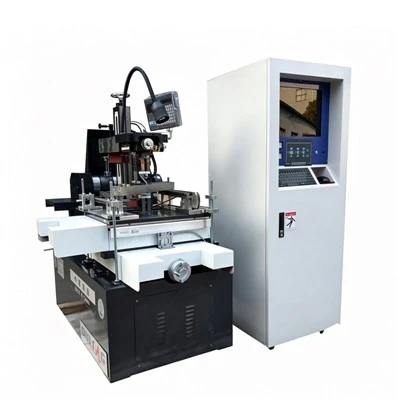
Now, if you’re reading this and wondering if a ZNC die sinker EDM is right for your job, or if you have a specific part that needs a tight tolerance, hit me up. I’ve helped guys from small custom shops to big manufacturers figure out the right EDM for their needs, and I can tell you straight if a ZNC will work for your tolerance requirements, or if you need to step up to a CNC. No sales pitch, just honest advice. I don’t waste time on jobs that are over my head, but I’m really good at what ZNCs do, and I can deliver consistent tolerance without the high cost of CNC equipment.
ZNC Die Sinker EDM References:
- EDM Handbook: Principles and Applications, 4th Edition, Society of Manufacturing Engineers, 2021.
- Industrial Machining Tolerance Standards, American Society of Mechanical Engineers (ASME B4.2), 2019.
- Field Performance Analysis of ZNC Die Sinker EDMs, Journal of Manufacturing Processes, Vol. 45, 2020, pp. 789-796.
Taizhou Ouling CNC Equipment Co., Ltd.
As one of the most professional znc die sinker EDM manufacturers and suppliers in China, we’re featured by quality products and good price. Please rest assured to buy advanced znc die sinker EDM made in China here from our factory. Welcome to contact us for quotation.
Address: No. 9 jingang Road, Yangzhou City Jiangsu Province, China
E-mail: 574751243@qq.com
WebSite: https://www.oulingedm.com/
